Relax is CBD-forward: CBD makes up most of the supporting blend, with small amounts of CBG, CBC and CBN for a fuller profile. It carries a third of the CBN in Sleep, because Relax is built for the evening, not for lights-out.
How your endocannabinoid system works
Your endocannabinoid system (ECS) is a signaling network your body uses to help keep things in balance, including mood, stress response, appetite, sleep and memory. It has three parts: endocannabinoids your body makes on its own (like anandamide and 2-AG), the receptors they bind to (CB1, found mostly in the brain and nervous system, and CB2, found mostly in immune tissue), and enzymes that break them down when they're done (FAAH and MAGL). Plant cannabinoids interact with this same system, each in its own way.
EndocannabinoidsAnandamide and 2-AG: messengers your body makes on demand.
ReceptorsCB1 (brain and nerves) and CB2 (immune tissue) receive those messages.
EnzymesFAAH and MAGL clear the messengers once they’ve done their job.
In RelaxThe same 10mg per segment as every GURU gummy. It sets the strength; the blend around it sets the character.
With your ECSActivates CB1 receptors (a partial agonist), which is where its intoxicating effect comes from. Also acts on CB2.
What research saysThe most studied cannabinoid. Effects depend strongly on amount: lower amounts are generally better tolerated, while higher amounts raise the chance of anxiety or an uncomfortable experience.
Well studied In RelaxMost of the blend: a CBD-forward base for a softer experience than THC alone.
With your ECSBarely binds CB1 or CB2 directly. It can change how CB1 responds to THC, slows the enzyme (FAAH) that breaks down your own anandamide, and acts on serotonin 5-HT1A and TRPV1 receptors.
What research saysNon-intoxicating and widely studied. Whether it softens THC's effects depends on the ratio and amount, and studies are mixed.
Well studied In RelaxA small amount for a fuller cannabinoid profile.
With your ECSBinds CB1 and CB2 weakly. Also acts on alpha-2 adrenergic receptors and blocks 5-HT1A serotonin receptors.
What research saysNon-intoxicating. A small 2024 double-blind human study found a 20mg dose reduced self-reported anxiety and stress in healthy adults. Promising, but early.
Early research In RelaxA small amount, non-intoxicating.
With your ECSWeak at CB1, some activity at CB2. Mainly acts on TRPA1 and TRPV1 receptors and may slow the reuptake of anandamide.
What research saysNon-intoxicating. Most research so far is in lab and animal studies.
Mostly lab research In RelaxA light touch, a third of what Sleep carries.
With your ECSA weak CB1 partial agonist: it acts on the same receptor as THC, but far more gently. Forms naturally as THC ages.
What research saysWidely used in nighttime products. The few human studies on sleep are small and results are mixed.
Early research What we can and can't say: THC's effects are well documented. Research on the other cannabinoids is still early. Many findings come from lab or animal studies or small human trials, often at higher amounts than one segment contains. The biggest driver of how a segment feels is its 10mg of THC. Each supporting blend is our formulation choice for that vibe, and we'll keep refining it with Vibe Study feedback.
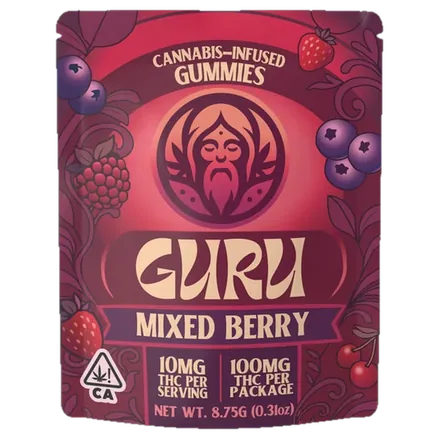 Mixed Berry
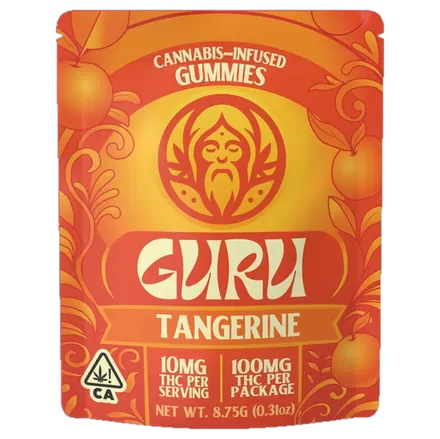 Tangerine